Kanazawa Castle stands in substantial park grounds in the center of Kanazawa City, and is just across the road from Kanazawa’s other big attraction, Kenrokuen Garden. The castle has played a central role in Kanazawa’s history and though once neglected, it has been extensively rebuilt and renovated in recent years.
The park itself is free to enter and parts of the castle can also be freely explored. For a small fee you can also enter some of the reconstructed buildings and learn how the castle was constructed as well as enjoy the view from the castle windows. It is an essential stop on any tour of the city.
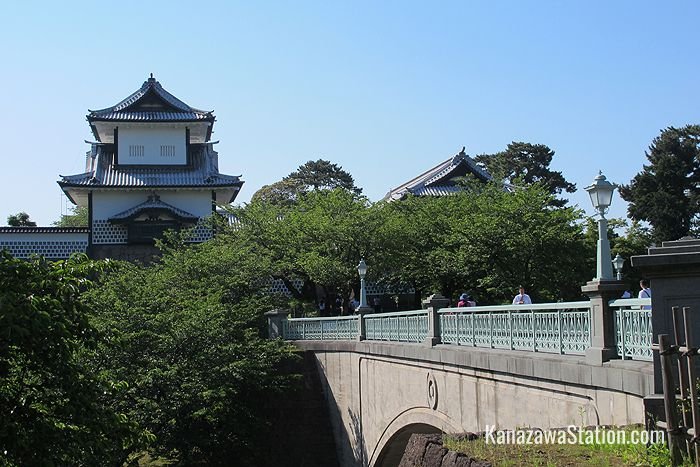
Approaching the castle’s Ishikawa-mon Gate from Kenrokuen Garden
Table of Contents
History
The plateau on which Kanazawa Castle stands is a natural position of strength and it has been the regional center of power since the fifteenth century. At that time the old Kaga Province was controlled by an independent Buddhist state called the “Peasants’ Kingdom”. The stronghold of this kingdom was a fortified temple, called Kanazawa Mido or Oyama Gobo, which was built on the plateau in 1546.
In 1580 Kaga Province was brought back under the control of the central government when Sakuma Morimasa, serving Oda Nobunaga’s side, captured Kanazawa Mido and began developing the castle. In 1583, after the Battle of Shizugatake, Maeda Toshiie entered Kanazawa Castle and began the Maeda family’s long rule from the site. The Maeda family oversaw the building of most of the buildings in the castle complex, and the city of Kanazawa grew up around it.
As the Maedas prospered, so did Kanazawa city, becoming a center of culture famed for its gold and silver craftwork, lacquerware, ceramics, and silk. These glory years of Maeda rule are remembered fondly in Kanazawa, and every June the Hyakumangoku Festival parade commemorates the first Maeda lord’s entry into Kanazawa Castle.
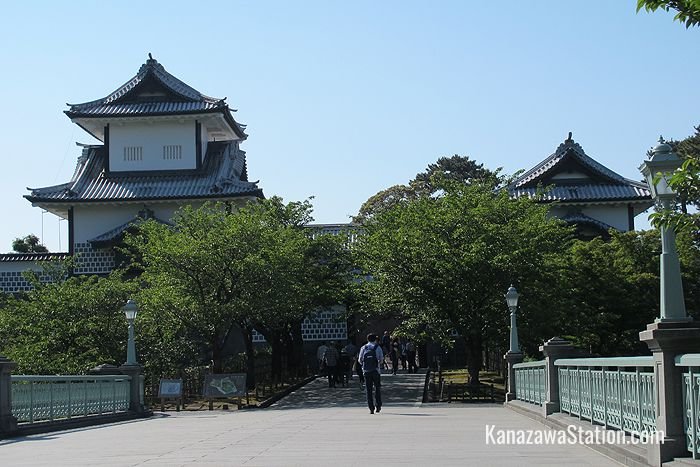
The Ishikawa-mon Gate dates from 1788, and is one of the few structures that survived the fire of 1881
Over the centuries the castle suffered repeatedly from fires and later from neglect. The castle tower burnt down in 1602 and was never replaced. In the Great Kanazawa Fire of 1759 the castle was almost completely destroyed and had to be rebuilt, and several buildings were again lost to fire in 1881. In the early 20th century, the castle grounds were occupied by a military barracks, and the castle moats were filled in. After World War 2 public tennis courts were constructed on the castle grounds, and Kanazawa University had its campus on the site until the 1990s. Happily, local government took control of the site in 1996, and since that time many of the castle’s buildings have been rebuilt and a portion of the moat has been restored too. Today Kanazawa Castle has regained its rightful place as a proud symbol of the city’s heritage.
The Kahoku-mon Gate
In Maeda times the Kahoku-mon Gate would have been the main entrance to Kanazawa Castle. A gate rebuilt after the Great Kanazawa Fire of 1759 stood here into the Meiji period, but it was removed around 1882. The present reconstruction was completed in 2010 using historically accurate materials: a wooden framework, outer stone walls, white plaster, and a lead-tile roof. The reconstruction of all the castle buildings is based on painstaking research of old documents, photographs, and archaeological finds, as well as relying on traditional local construction techniques.
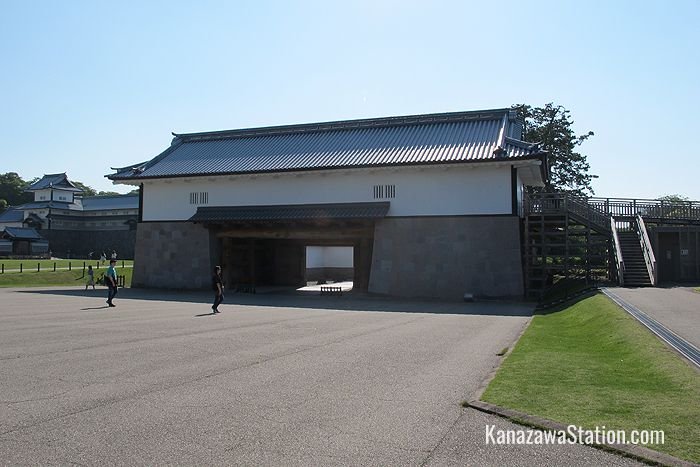
The Kahoku-mon Gate
Inside the gate there are some displays relating to its history and construction. Entrance is free and it is open from 9.00 till 16.30 with last entries at 16.00.
The Turrets & Storehouse
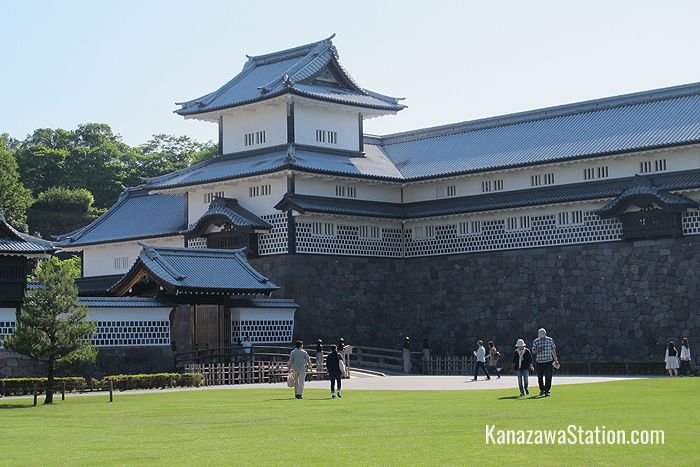
Approaching the reconstructed turret of Hashizume-mon Tsuzuki Yagura
Beyond the Kahoku-mon Gate are two turrets and a storehouse that runs between them. These were reconstructed between 1999 and 2001 and form the most impressive part of the castle complex. To enter them you need to pay a small fee, but it is well worth it to see the extraordinary interior carpentry, the display models and artifacts, and to enjoy a samurai’s-eye view from the turret windows.
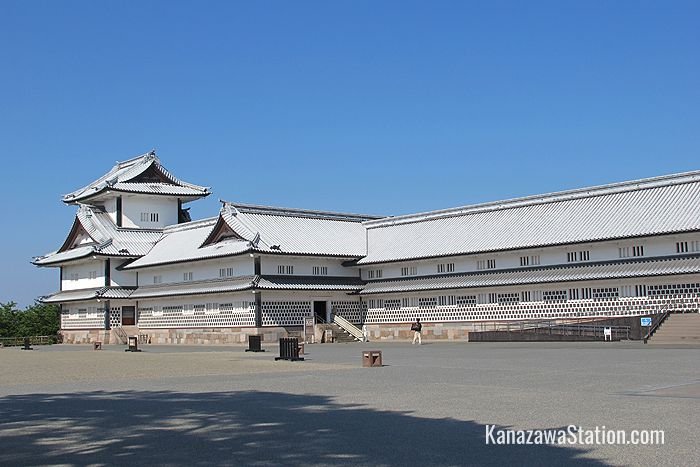
The entrance to the Gojikken Nagaya storehouse. The turret at the far end is called Hishi Yagura
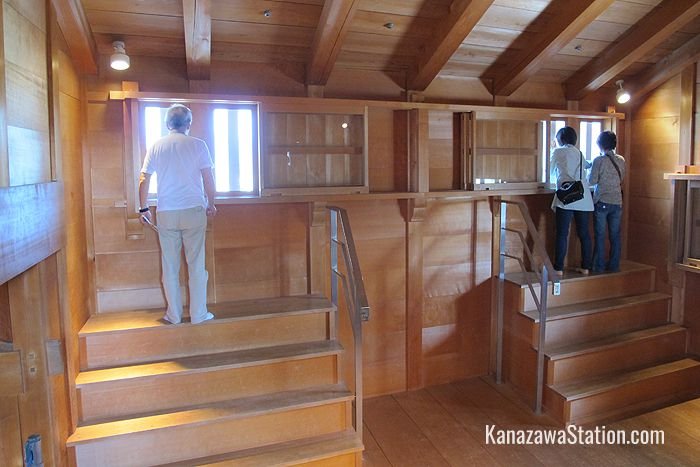
Taking a peek from the “stone-dropping” windows
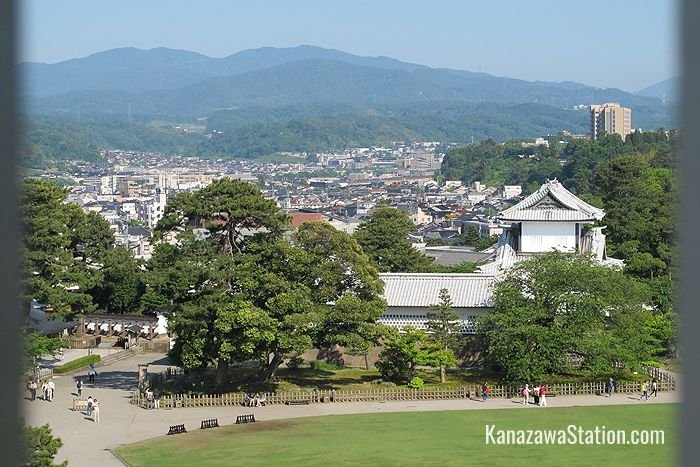
A view from the Hishi Yagura turret
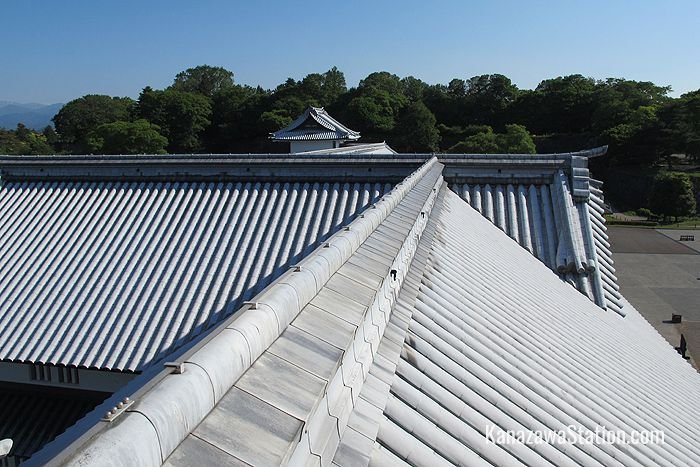
The roof tiles of the castle were made from lead. It was said these could be melted down for bullets if the castle was attacked!
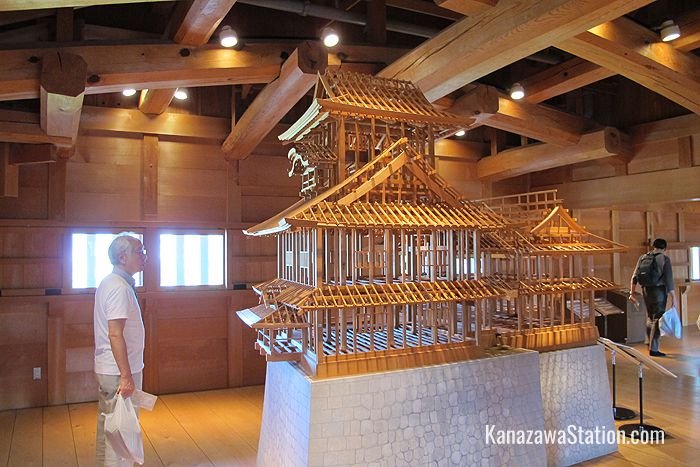
A scale model of the original structure. Models like this were used by carpenters to plan the reconstruction process
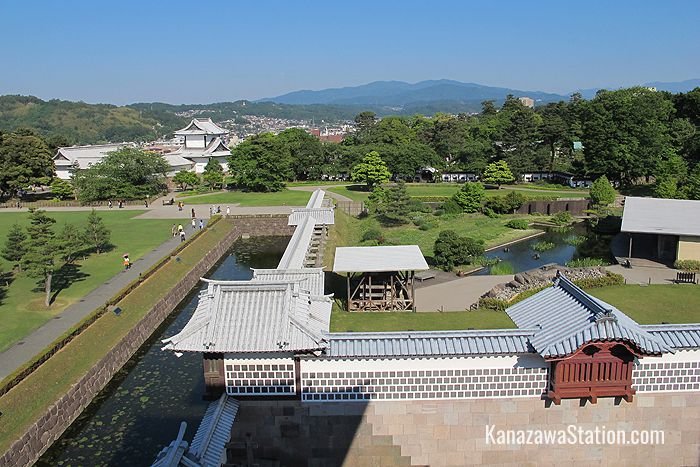
A samurai’s-eye view from the turret of Hashizume-mon Tsuzuki Yagura
The Hishi Yagura, Gojikken Nagaya, Hashizume-mon Tsuzuki Yagura, and Hashizume-mon are open from 9.00 to 16.30 with last entry at 16.00. Entry for adults aged 18 and over is 320 yen, and for children between 6 and 17 years old it is 100 yen.
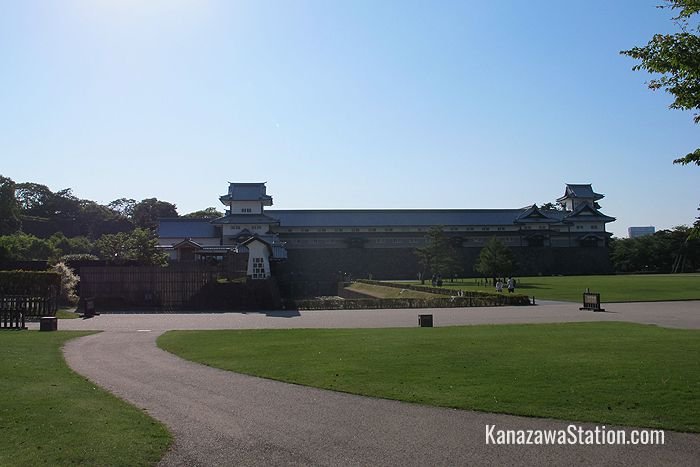
Kanazawa Castle Park
Access
The Ishikawa-mon Gate of Kanazawa Castle Park is about a 5 minute walk from the Kenrokuen Garden / Kanazawa Castle Park bus stop. From Kanazawa Station East Gate bus stop 7, the Kanazawa Loop Bus right route runs about every 15 minutes and reaches the stop in roughly 18 minutes; the left route runs about every 20 minutes and takes longer. The flat fare is 220 yen for adults and 110 yen for children. A taxi from Kanazawa Station usually takes about 10 minutes.
Opening Hours
The opening hours for Kanazawa Castle Park are as follows:
March 1st – October 15th: 7.00 – 18.00
October 16th – the end of February: 8.00 – 17.00
Article and original photos by Michael Lambe. All rights reserved. Last updated 19-May-2026.